
how to fix car power outlet not working cigarette lighter usually comes down to one of three things: a blown fuse, a dirty or damaged socket, or a charger plug that is failing even though it looks fine.
If you rely on that outlet for phone charging, a dash cam, GPS, or an air pump, this “small” failure gets annoying fast, and in some cars it also hints at a bigger electrical issue you don’t want to ignore.
I’ll walk you through quick checks first, then deeper troubleshooting with safe, realistic next steps, plus a simple table to help you narrow the cause without guessing.
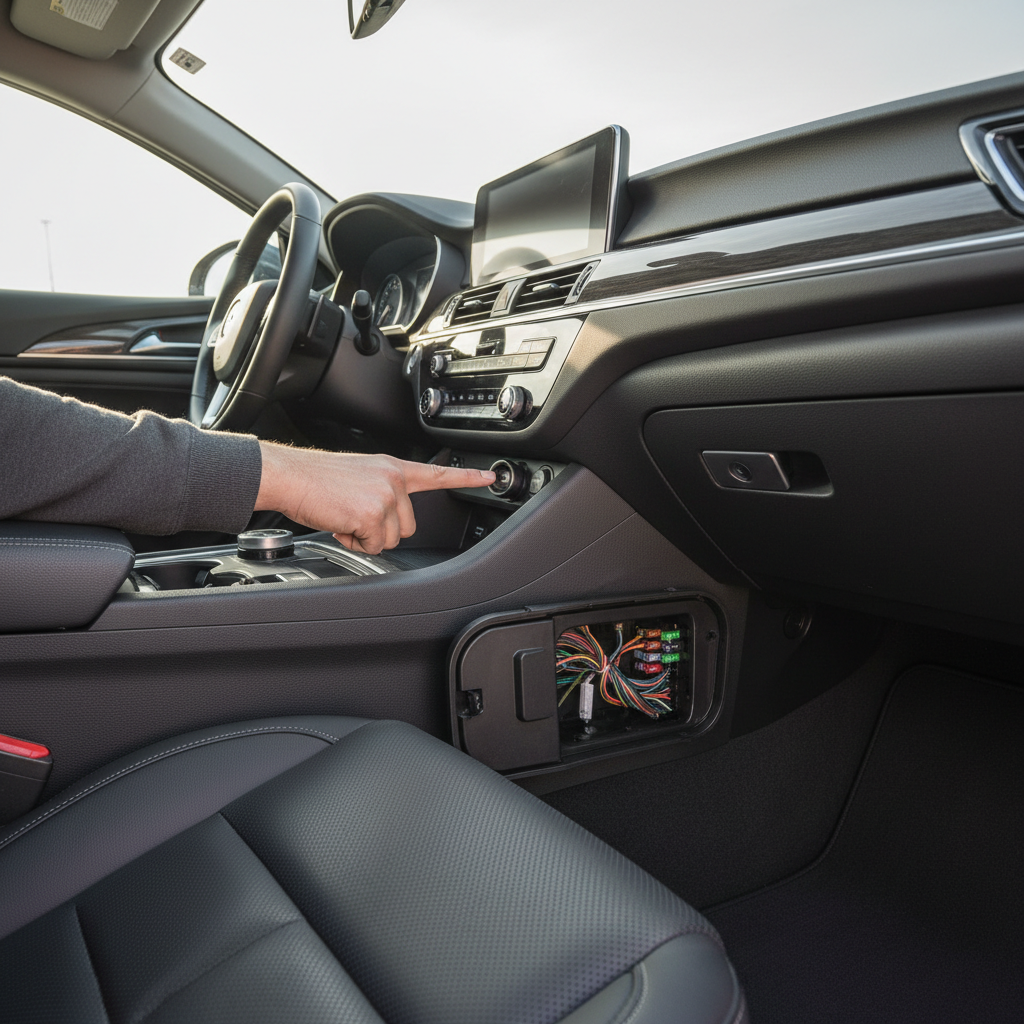
Start with the fastest sanity checks (before tools)
Before you pull trim pieces or buy parts, confirm the outlet is actually the problem. A surprising number of “dead sockets” are just a bad USB adapter or a plug that no longer fits tightly.
- Try a different device (another charger, another 12V accessory). If one works and the other doesn’t, your outlet may be fine.
- Check ignition position. Many vehicles power the outlet only in ACC/ON, not with the car fully off.
- Look for a loose fit. If the plug wiggles or pops out, the socket’s internal contacts can be spread or worn.
- Smell/visual check. Any burnt smell, discoloration, or melted plastic means stop and move to the fuse + wiring section.
If nothing powers up with multiple accessories and the car is in ACC/ON, move on to the fuse check, it’s the most common fix.
Most common cause: blown fuse (and why it keeps happening)
For many people, the answer to how to fix car power outlet not working cigarette lighter is simply replacing the correct fuse, but you also want to know why it blew so it doesn’t repeat next week.
According to NHTSA, vehicle electrical fires and overheating risks are often tied to improper modifications, damaged wiring, or incorrect replacement parts, so treat repeated fuse blowing as a warning, not a “feature.”
How to find and test the outlet fuse
- Find your fuse box locations (often one under dash, one in engine bay). Use the owner’s manual fuse diagram.
- Look for labels like CIG, PWR OUTLET, 12V, or ACC.
- Pull the fuse with a fuse puller. If the metal strip is broken, it’s blown.
- Best practice: use a multimeter or a simple fuse tester light to confirm continuity, because some blown fuses look “almost fine.”
Replace it the right way
- Replace with the same amperage rating (example: 15A with 15A). Don’t “upgrade” to a bigger fuse to stop it from blowing.
- If the new fuse blows immediately, stop using the outlet and jump to the wiring/short section below.
Quick diagnosis table: symptom → likely cause → what to do
If you’re not sure where you fall, use this to narrow it down without chasing every possibility.
| What you see | Likely cause | Practical next step |
|---|---|---|
| No power at all, multiple chargers fail | Blown fuse, no feed power, or bad ground | Check fuse, then test socket voltage/ground with multimeter |
| Works only when you wiggle the plug | Worn socket contacts or loose socket housing | Inspect socket tension, check mounting, consider socket replacement |
| Fuse blows when you plug in one accessory | Accessory short or overload | Stop using that accessory, test with a different one, verify current draw |
| Socket feels hot or smells burnt | High resistance connection, melted plastic, wiring damage | Disconnect, inspect socket and wiring, professional diagnosis recommended |
| USB charger lights up but phone won’t charge | Bad adapter/cable or low-quality charger | Try a known-good charger/cable rated for your device |
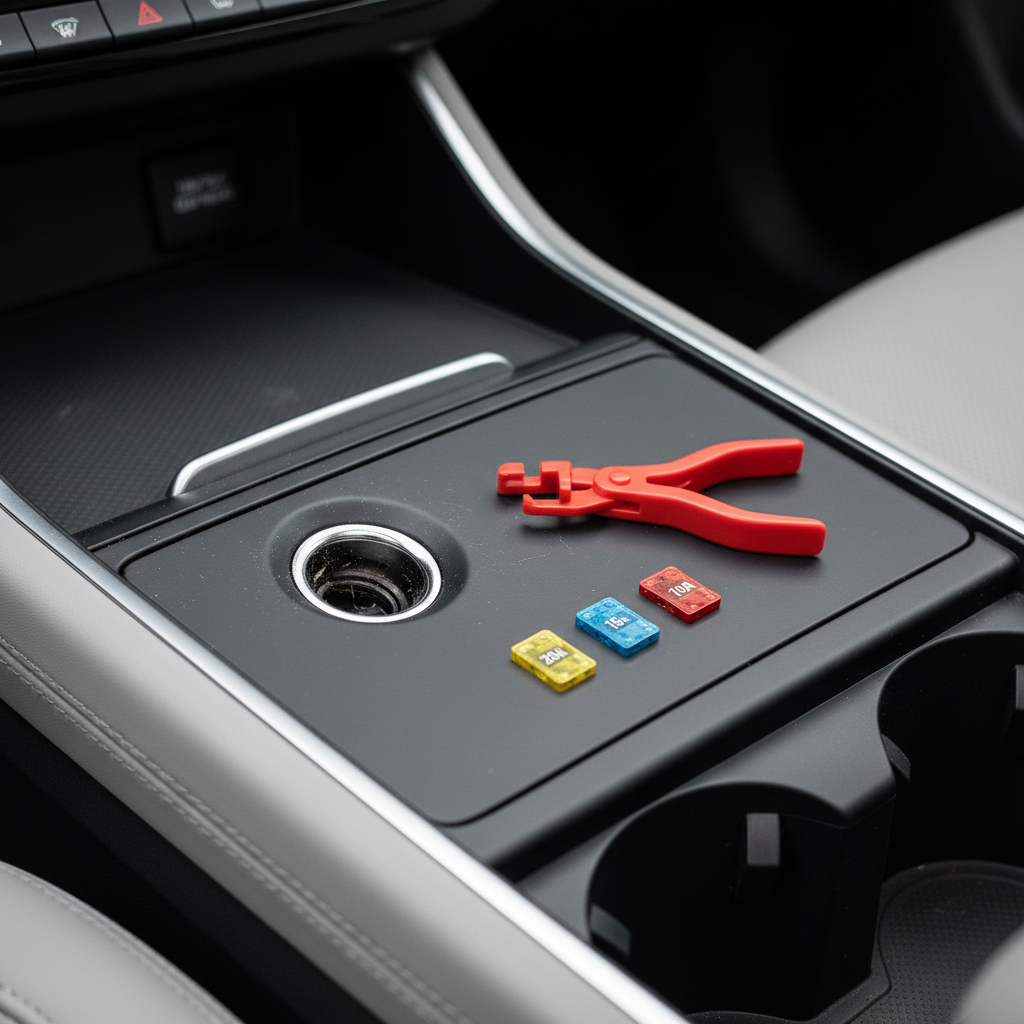
Socket problems: debris, corrosion, bent center pin, loose contacts
If your fuse is good, the socket itself becomes the prime suspect. Coins, metal wrappers, and even tiny bits of foil can short the center contact to the outer shell, and corrosion can keep a “good” outlet from delivering usable power.
Safe inspection and cleaning
- Turn the car off. For extra safety, you can disconnect the negative battery terminal if you’re going to touch wiring.
- Use a flashlight to look inside the socket. You’re checking for foreign objects, charring, or a center contact pushed down too far.
- Remove loose debris with plastic tweezers or compressed air. Avoid metal tools inside the socket.
- If corrosion is visible, a small amount of electrical contact cleaner can help, let it fully dry before testing.
When the socket is physically worn
If plugs won’t stay seated or only charge at a certain angle, the internal spring contacts may be spread. In many vehicles, replacing the entire outlet assembly is inexpensive and more reliable than trying to “bend it back” repeatedly.
Test for power and ground with a multimeter (simple, not scary)
This is the step people skip, then they end up swapping parts. A basic voltage test tells you whether the issue is upstream (wiring, relay, fuse feed) or the socket itself.
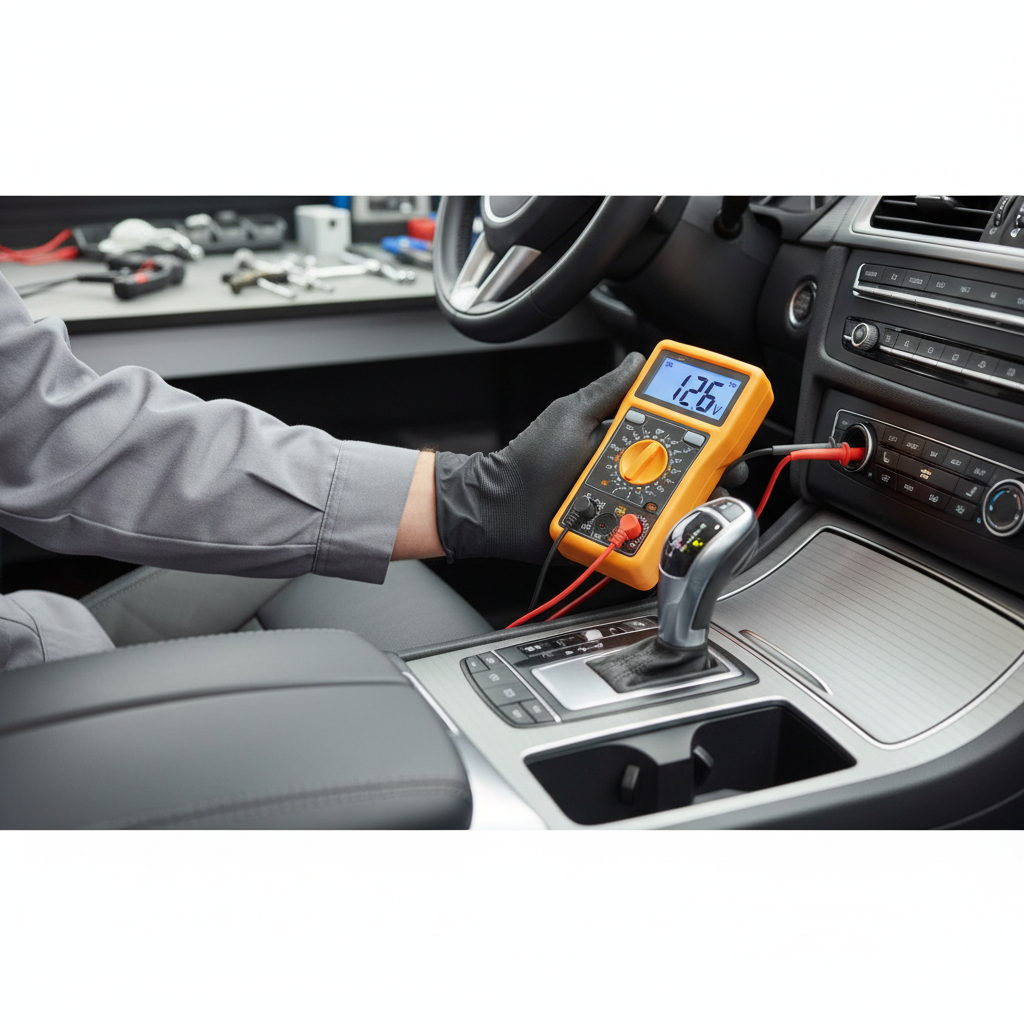
- Set multimeter to DC volts (20V range on many meters).
- Black probe to a known good ground (bare metal bolt) or the outlet outer shell.
- Red probe to the center contact inside the socket.
- With ignition in the required position, you typically expect around 12–14V in a running vehicle.
What the readings mean: If you get proper voltage at the center contact but devices still don’t work, the socket contact tension or the adapter is likely the issue. If voltage is missing, trace back to fuse feed, wiring, or an outlet control module depending on the vehicle.
Deeper causes: wiring damage, shared circuits, and smart outlet modules
Some cars tie the cigarette lighter circuit to other accessories, so the clue might be “my outlet died and my interior lights act weird” or “my rear outlet works but front doesn’t.”
- Shared circuit overload: plugging an inflator or inverter can exceed the circuit rating, especially if other items share it.
- Pinched wiring: common near center consoles after stereo installs, dash cam hardwires, or spilled drinks that wick into connectors.
- Rear seat/outlet child damage: coins and metal objects dropped into the socket can cause repeated shorts.
- Smart power management: some vehicles shut outlets down when they detect a fault, and a scan tool may be needed to see stored codes.
If you’re at the point of removing console panels, go slowly. Plastic clips break easily, and a “simple outlet fix” turns into rattles if you rush it.
Step-by-step fix plan (choose your situation)
If you want a straightforward path, use this plan and stop as soon as you find the failure point.
Situation A: Everything is dead
- Confirm outlet needs ACC/ON, then test with a known-good accessory.
- Check and replace the correct fuse with same rating.
- Test for 12V at the socket with a multimeter.
- If no power: check for power at the fuse output side, then inspect wiring/connector behind the outlet.
Situation B: Works intermittently or plug won’t stay tight
- Inspect the socket for damage and heat marks.
- Try a different adapter with a slightly longer tip (some cheap adapters are short and make poor contact).
- If still flaky: replace the outlet assembly, it’s often the most time-efficient fix.
Situation C: Fuse keeps blowing
- Stop using the last accessory that triggered it, that accessory may be shorted.
- Inspect the socket carefully for metal debris.
- If it blows with nothing plugged in, a short to ground in the wiring is likely, professional diagnosis becomes the safer choice.
Common mistakes that waste time (or create new problems)
- Installing a higher-amp fuse to “fix” blowing fuses, this can raise overheating risk.
- Assuming the outlet is bad when the USB adapter is the real culprit, especially with no-name fast chargers.
- Probing inside the socket with metal tools while power is present, easy way to create a short.
- Ignoring heat. A hot socket is telling you something, don’t keep using it “just for now.”
- Mixing up similar fuses in the panel. Double-check labels and amperage before you re-seat everything.
According to NFPA, electrical malfunctions are a recognized source of fires in general, so if you see melting or repeated faults, it’s reasonable to treat this as a safety issue and escalate.
When it’s time to get professional help
You can handle many outlet fixes at home, but a few situations justify a shop visit, especially if you’re not comfortable with trim removal or electrical testing.
- New fuse blows immediately, even with nothing plugged in.
- Burnt smell, smoke, melted socket, or wiring insulation damage.
- Multiple electrical issues appear at once (windows, radio, interior lights), suggesting a broader fault.
- Your vehicle uses a control module for accessory power and needs scan-tool diagnostics.
In many cases a technician can pinpoint the exact short location faster with a wiring diagram and a current clamp, and that saves you from replacing parts by guesswork.
Wrap-up: get the outlet back without chasing random fixes
If you’re still thinking about how to fix car power outlet not working cigarette lighter, the most reliable flow is simple: verify the accessory, check the correct fuse, inspect and clean the socket, then confirm voltage with a meter before you buy parts.
Action-wise, do two things today: swap in a known-good charger and inspect the fuse labeled CIG/12V. If the fuse blows again or you see heat damage, pause and have it diagnosed, that’s the point where “quick DIY” can turn into a bigger electrical repair.
Key takeaways
- Fuse issues are the most common and the quickest to verify.
- Loose plugs often point to worn socket contacts, not the car battery.
- Repeated fuse blowing usually means a short or overload, not bad luck.
- Heat or melting is a stop sign, not an inconvenience.
FAQ
Why did my cigarette lighter stop working but other outlets still work?
Many vehicles split outlets across different fuses or even different power modes. It’s common for a front console socket to be on its own fuse while a rear outlet is on another circuit, so checking the specific fuse label matters.
Is it safe to replace the cigarette lighter fuse myself?
Usually yes if you match the amperage and the correct slot, and you’re not forcing anything. If the fuse blows again right away, stop and consider professional help because a short circuit may exist.
What fuse controls the 12V power outlet?
It varies by make and model, common labels include CIG, PWR OUTLET, ACC, or 12V. The owner’s manual or the fuse box cover diagram is the fastest way to confirm.
My outlet has power but my phone won’t charge, what’s going on?
This is often the adapter or cable, not the socket. Some USB adapters light up even when they can’t deliver stable current, trying a known reputable charger is an easy check.
Why does the outlet work only when I push the plug in hard?
That usually points to weak contact pressure inside the socket or a plug tip that’s too short. Cleaning can help, but if it keeps happening, replacing the socket assembly is often the cleaner fix.
Can a coin in the socket really blow a fuse?
Yes. A coin or metal fragment can bridge the center contact and the outer shell, creating a direct short. If you suspect this happened, remove debris carefully with the car off.
What if the fuse is fine and the socket looks clean, but it still won’t work?
At that point, a multimeter test is the quickest way forward. If there’s no 12V at the socket, the problem is upstream in wiring, connectors, or a control module, and a wiring diagram becomes useful.
If you’re trying to restore power quickly for a dash cam, phone charging, or a road-trip accessory, and you’d rather not troubleshoot wiring yourself, a local automotive electrician or a reputable repair shop can usually confirm the fault in one visit and recommend whether a fuse, socket, or harness repair makes sense for your car.