
how to diagnose car bad coolant temperature sensor is mostly about separating a bad sensor from a wiring problem, a thermostat issue, or a cooling system problem that only looks like an electrical fault.
If you’ve got a temperature gauge that reads cold forever, pegs hot right after startup, an electric fan that runs at weird times, or a check engine light tied to coolant temperature, the coolant temp sensor (often called ECT) is a top suspect, but it’s not the only one. The good news is you can narrow it down with a few simple checks and a scan tool.
Below is a practical workflow that DIYers can follow without turning the driveway into a science lab. I’ll also call out the places people waste time, like swapping the sensor when the connector is green with corrosion or when the thermostat is stuck open.
What the coolant temperature sensor does (and why failures feel “random”)
The ECT sensor reports engine coolant temperature to the ECU (engine computer). The ECU uses that number to control fuel mixture, ignition timing, idle strategy, emissions systems, and in many cars even the radiator fan logic.
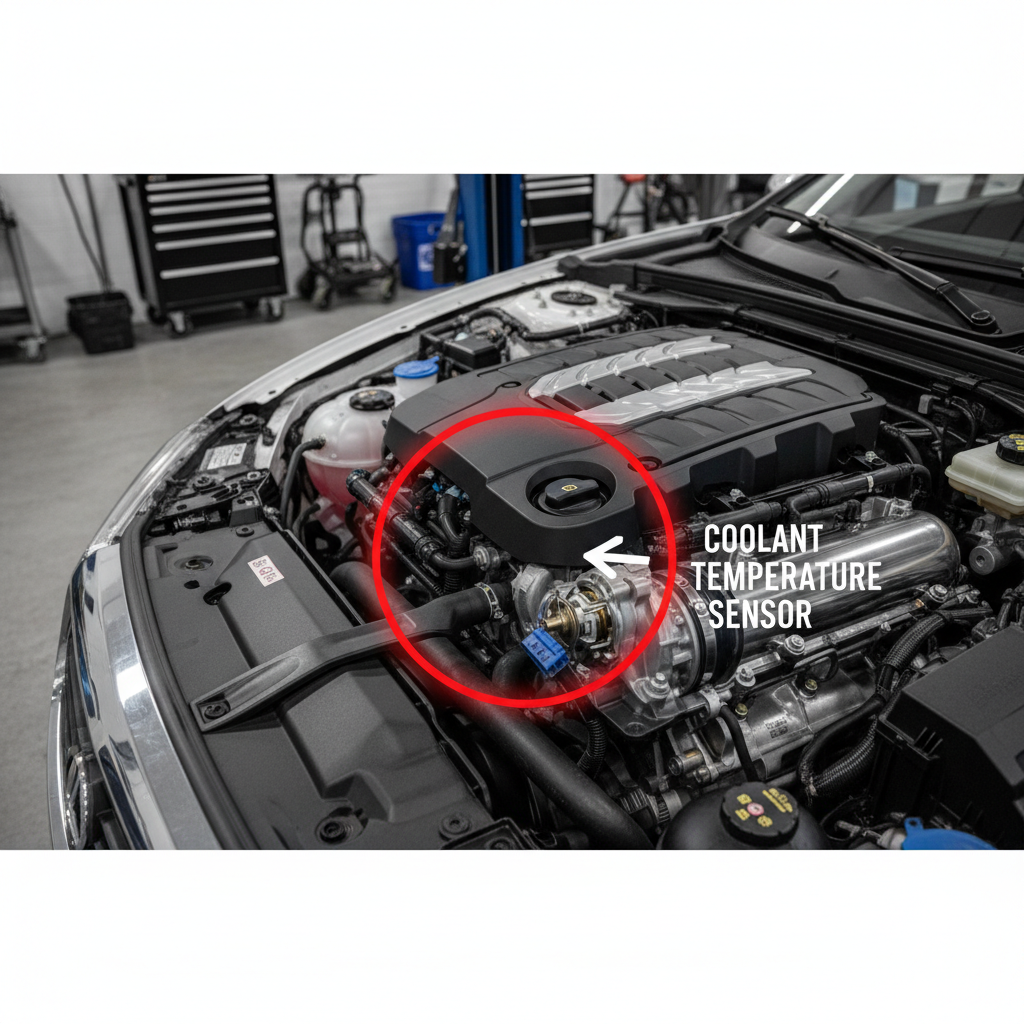
Most ECT sensors are thermistors, meaning resistance changes with temperature. Typically, resistance is high when cold and lower when hot. When the signal is wrong, the ECU may think the engine is ice-cold (adds extra fuel) or overheating (may command fans on, adjust timing, and trigger warnings).
According to SAE International, OBD-II systems monitor sensor circuits for plausibility and electrical faults, which is why you’ll often see circuit-related codes when the ECT signal is out of expected range.
Common signs of a bad coolant temperature sensor (and what else can mimic it)
Before testing, match symptoms to likely causes. A “bad sensor” symptom list is useful, but it’s only helpful if you also know the look-alikes.
- Hard cold starts or rich running (fuel smell, black soot): could be ECT reading too cold, but also leaking injectors or MAF issues.
- Poor fuel economy: often seen when ECT reads cold, but low tire pressure and short trips can look similar.
- Cooling fan runs constantly: can happen with an ECT circuit fault, but also with an A/C request, fan relay stuck, or another temp sensor input depending on vehicle design.
- Temp gauge reads wrong: some cars use a separate sender for the gauge, others share data from the ECU.
- Check engine light with ECT codes: good clue, but still verify wiring/connector.
Quick reality check: if the engine is truly overheating (steam, coolant smell, overflow pushing coolant), don’t keep driving just to “test.” Overheat damage can happen fast, and it’s usually not caused by the sensor alone.
Fast self-check: are you dealing with sensor, wiring, or cooling system?
This short checklist helps you decide where to spend your time next.
- Does the scan tool temperature match reality? After sitting overnight, ECT should be close to outside air temp.
- Does the car overheat in real life? If yes, prioritize cooling system basics: coolant level, leaks, airflow, thermostat, water pump.
- Any obvious connector issues? Broken lock tabs, coolant/oil intrusion, green corrosion, stretched pins.
- Does wiggling the harness change the reading? That points toward wiring/connector intermittents.
- Any related codes? P0115–P0119 and “circuit high/low” language often indicates electrical problems, not just “bad sensor.”
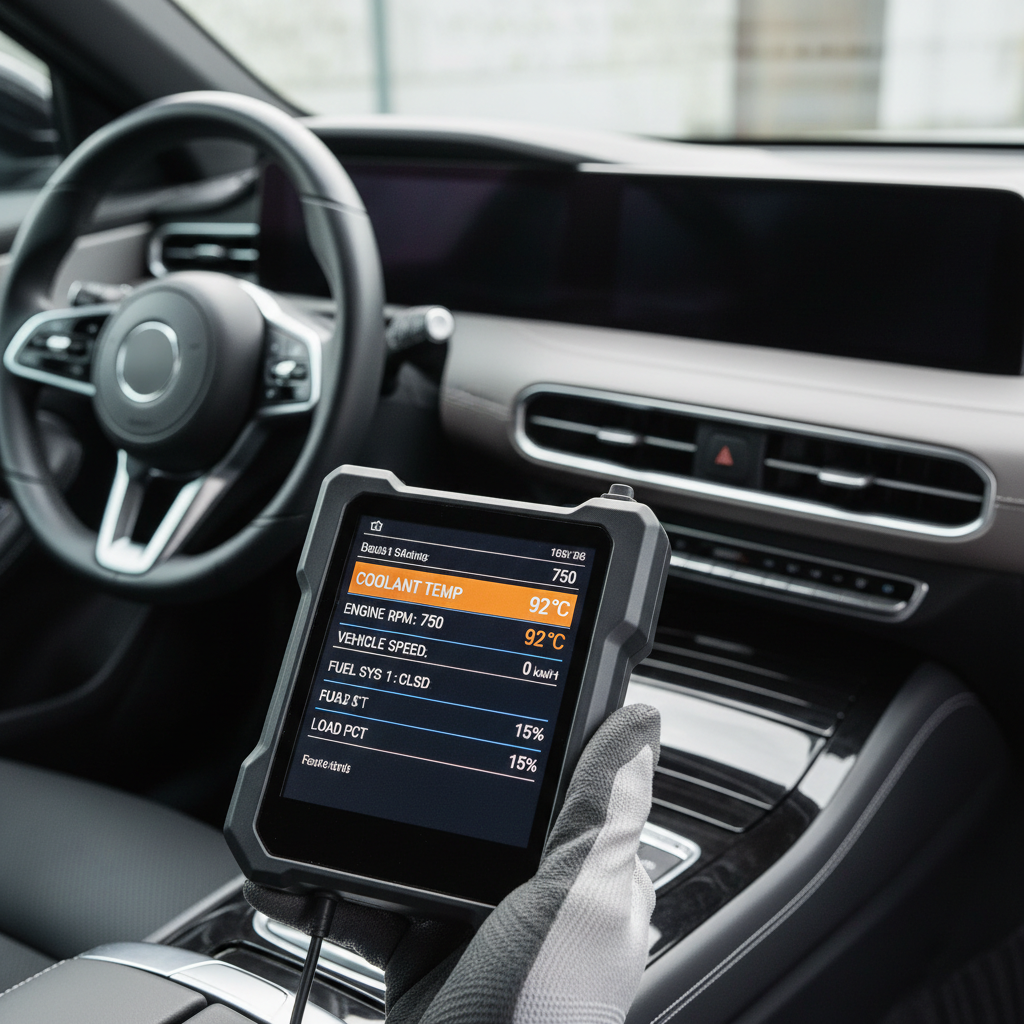
If you only do one thing before buying parts, do the overnight cold reading comparison. It’s simple and it catches a lot of false diagnoses.
Tools you actually need (and what each one tells you)
- OBD2 scanner with live data: shows ECT value the ECU sees, plus fuel trims and fan commands on many vehicles.
- Digital multimeter: checks sensor resistance, reference voltage, ground integrity, and signal behavior.
- Infrared thermometer (helpful, not mandatory): gives a quick surface temp estimate near thermostat housing or upper radiator hose.
- Basic hand tools: to access connector, remove engine cover, or replace sensor if needed.
Don’t overthink the scanner choice. For this job, stable live data matters more than brand prestige.
Step-by-step: how to diagnose a car bad coolant temperature sensor
how to diagnose car bad coolant temperature sensor goes smoother when you start with the easiest “high-signal” tests, then move toward wiring and component measurements.
1) Check cold-start plausibility (best first test)
Leave the car off overnight. In the morning, key on (engine off) and read ECT on your scan tool.
- If ECT is within about 5–15°F of ambient temp, the sensor circuit is at least plausible.
- If it reads -40°F (or a very low default), many ECUs use that as a sign of an open circuit (unplugged sensor, broken wire).
- If it reads 250–300°F instantly, that often suggests a short to ground or sensor internally shorted, depending on the system.
Exact default numbers vary by make, but the “absurdly cold” and “absurdly hot” patterns are consistent across many vehicles.
2) Warm-up behavior test (spot stuck thermostat vs bad signal)
Start the engine and monitor ECT. A normal warm-up is a smooth climb as the engine heats.
- ECT climbs very slowly and never reaches normal: often a thermostat stuck open, not a sensor.
- ECT jumps around (for example 120°F to 190°F to 140°F): could be a loose connection, failing sensor element, or harness issue.
- Gauge says hot but scan tool says normal: could be a separate gauge sender, cluster issue, or wiring specific to the gauge circuit.
3) Connector and harness inspection (where many “bad sensors” live)
With the engine cool, unplug the sensor connector and look closely.
- Check for coolant wicking into the connector, which can happen if the sensor leaks through the body.
- Look for green corrosion, bent pins, or a connector that doesn’t click/lock.
- Follow the harness a short distance for rub-through near brackets and hot exhaust parts.
If you find corrosion, cleaning and repairing the connector often fixes the issue longer than swapping the sensor alone.
4) Circuit quick test with a multimeter (reference voltage and ground)
Many ECT sensors use a 2-wire circuit: one 5V reference from the ECU and one signal return/ground (design varies). With key on, back-probe carefully.
- No reference voltage: suspect ECU supply issue or an open in the reference circuit shared with other sensors.
- Bad ground (high resistance to battery negative): wiring/ground point issue, and the sensor will “lie” even if it’s fine.
If you’re not comfortable back-probing without damaging terminals, it’s reasonable to stop here and ask a shop. Bent terminals create brand-new problems.
5) Sensor resistance test (bench-style, but doable on-car)
With the sensor unplugged, measure resistance across the sensor pins and compare to the service manual chart for your vehicle. If you don’t have the chart, you can still do a sanity check:
- Cold engine: resistance should typically be higher.
- Hot engine: resistance should typically be lower.
- If resistance is open (OL) or near-zero regardless of temperature, the sensor is likely bad.
Because specs vary, the pattern matters more than a single number unless you can access OEM specs.
6) Cross-check with an infrared thermometer (optional, very helpful)
A cheap IR thermometer can help confirm whether the ECU’s ECT reading is believable. Aim at the thermostat housing area or the metal near the sensor boss, not shiny surfaces that can distort readings.
- If IR shows around 190–210°F at operating temp but scan data insists 140°F, you likely have an ECT signal problem.
- If both IR and scan show low temps and the cabin heat is weak, thermostat stuck open becomes more likely.
Diagnosis cheat sheet table (symptoms → likely cause → next move)
| What you see | More likely cause | Best next check |
|---|---|---|
| ECT reads -40°F (or extremely low) on scan tool | Open circuit or unplugged sensor | Inspect connector, check continuity, verify 5V ref |
| ECT reads 250–300°F instantly on cold start | Shorted sensor or short in wiring | Unplug sensor and recheck scan reading, inspect harness |
| ECT warms very slowly, never reaches normal | Thermostat stuck open | Watch warm-up curve, check heater output, consider thermostat |
| Gauge reads hot, scan tool reads normal | Gauge sender/cluster issue (vehicle-dependent) | Check if separate sender exists, inspect cluster wiring |
| Fans run all the time, no overheat in real life | Fail-safe strategy due to ECT circuit fault | Scan for codes, check connector corrosion and wiring |

Fix options and practical next steps (by scenario)
Once you’ve narrowed the cause, the fix is usually straightforward, but do it in the right order to avoid parts darts.
If the sensor tests bad
- Replace the sensor with a quality part that matches OEM spec.
- Use a new sealing washer/O-ring if required.
- Refill and bleed the cooling system as your service manual specifies, trapped air can cause erratic readings.
If the connector or wiring is the problem
- Repair damaged pins, replace the pigtail if the plastic is heat-brittle or terminals are loose.
- Route and secure the harness away from exhaust and sharp edges.
- Clear codes and verify live data behavior on the next cold start.
If it’s actually a thermostat or cooling system issue
- For a stuck-open thermostat, replacement often restores normal operating temp and fuel economy.
- For overheating, don’t blame the sensor until you check coolant level, leaks, radiator airflow, and fan operation.
- If you suspect head gasket issues (persistent coolant loss, bubbles, milky oil), consider professional diagnosis.
Common mistakes that waste time (or create new problems)
- Replacing the sensor without checking the cold-start reading: it’s the quickest “is this plausible?” test you have.
- Ignoring corrosion: a new sensor plugged into a bad connector still reads wrong.
- Comparing IR readings to the wrong surface: shiny aluminum and painted parts can skew results.
- Mixing up sensor vs gauge sender: some vehicles have two separate pieces, confirm before buying parts.
- Working on a hot cooling system: hot coolant can spray under pressure, wait until cool if you’re unplugging sensors near the thermostat housing.
When it’s smarter to get professional help
If you’ve confirmed wiring power/ground issues, see multiple sensor codes at once, or the vehicle overheats for real, a professional shop can run pin-out tests, smoke tests for leaks, pressure tests, and manufacturer-specific scan routines faster and safer.
Also, if you’re unsure how to back-probe connectors without spreading terminals, it’s worth stopping early. Electrical diagnosis is very fixable, but it’s easy to make an intermittent fault worse with one heavy-handed probe.
Key takeaways (save this before you grab parts)
- Start cold: overnight ECT should be close to ambient temperature.
- Use live data: warm-up curves tell you a lot about thermostat vs sensor behavior.
- Inspect the connector: corrosion and loose pins are frequent culprits.
- Test the circuit: a “bad sensor” code can still be wiring, reference voltage, or ground.
Conclusion
Most people get unstuck once they treat ECT diagnosis like a short decision tree rather than a guessing game: confirm the cold reading, watch the warm-up trend, then decide whether you’re chasing sensor, wiring, or cooling system behavior. If your tests point clearly to the sensor, replacement is usually simple, but if readings swing with harness movement or you’re missing reference voltage, the fix is rarely the sensor itself.
If you want a low-effort next action, do this tomorrow morning: check the scan-tool coolant temp before starting the engine, then compare it to ambient. That single check often tells you whether you’re dealing with a real sensor fault or a different problem wearing the same costume.
FAQ
How do I know if my coolant temp sensor is bad or my thermostat is stuck?
A bad sensor often shows implausible readings (very low or very high) or erratic jumps on live data, while a stuck-open thermostat usually shows a slow, steady warm-up that never reaches normal operating temp and often weak cabin heat.
Can a bad coolant temperature sensor cause rough idle?
Yes, in many cars a wrong “cold” reading can enrich the mixture and change idle strategy, which may feel like rough idle, especially on warm restarts. Still, rough idle has many causes, so confirm with scan data rather than guessing.
What OBD2 codes relate to coolant temperature sensor problems?
Many vehicles use codes in the P0115–P0119 range for ECT circuit issues (range/performance, high/low input, intermittent). The exact code set depends on make and engine management design.
If the gauge reads hot but the scan tool temperature looks normal, what does that mean?
Often it means the gauge isn’t driven by the same sensor input, or there’s a cluster/gauge circuit issue. Some vehicles have a separate sender for the dashboard gauge, so confirming the system layout matters.
Is it safe to drive with a bad coolant temperature sensor?
Sometimes the car will run in a fail-safe mode and still drive, but fuel economy, drivability, and emissions can suffer, and you might miss a real overheating event. If you see actual overheating signs, it’s safer to stop and diagnose before continuing.
Do I need to drain coolant to replace the coolant temperature sensor?
Many designs will lose some coolant when the sensor is removed, and some require partial draining for a clean job. Check your vehicle’s service guidance, and plan to top off and bleed air afterward.
Why does my cooling fan run right after startup when the engine is cold?
That can happen when the ECU doesn’t trust the coolant temp signal and commands the fan as a protective default, but it can also be tied to A/C logic or a stuck relay. Scan codes and live data usually point you in the right direction.
Lightweight next step
If you’re working through how to diagnose car bad coolant temperature sensor and you’d rather avoid guessing, a basic OBD2 scanner with live data plus a simple multimeter check can cut the trial-and-error dramatically. If you already have readings or codes and want a second set of eyes, a reputable local shop can often confirm wiring vs sensor quickly without swapping parts blindly.